Table of Contents
Toggle
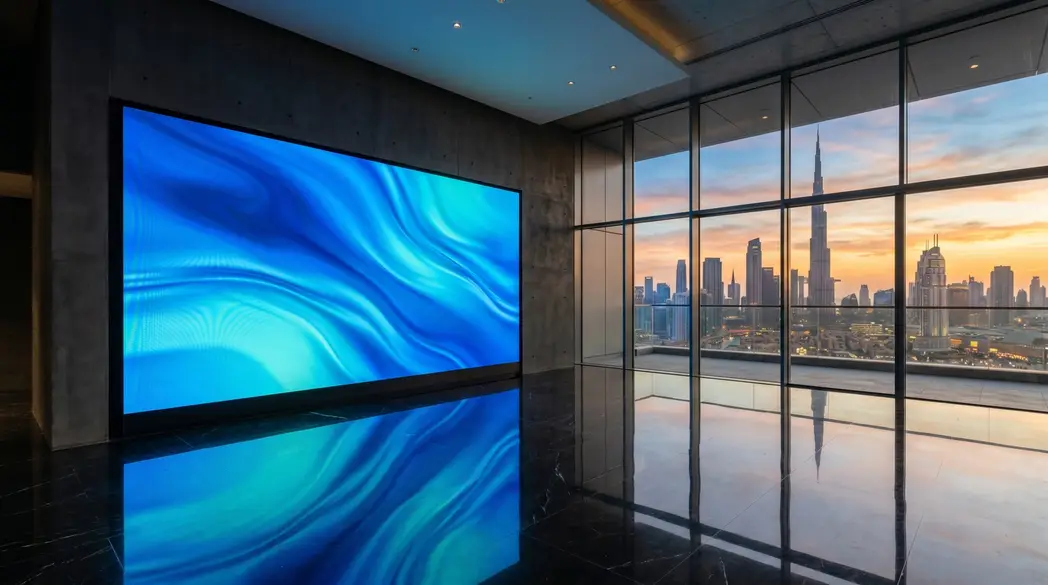
A digital display solution combines LED screens, video processors, AV control, and a content management system into one turnkey setup. In the UAE, the right specification depends on viewing distance, ambient brightness, and whether the screen lives indoors, outdoors, or in a hybrid space like a mall atrium. BeBright designs, supplies, and installs these systems across Dubai, Abu Dhabi, Sharjah, Riyadh, and the broader GCC.
Most LED installations in the UAE don’t fail because of bad pixels. They fail because someone bought the wrong screen for the wrong distance, mounted it without thinking about heat, or skipped the calibration step that separates a clean wall from a patchy one.
A digital display solution is what stands between a project that looks like it cost three times the budget and one that gets quietly replaced two years later. Get the spec right and the screen disappears – your content is all anyone notices. Get it wrong and the screen is the problem.
This guide is written for marketing teams, AV consultants, fit-out contractors, and facility managers who need to specify a digital display system in the UAE in 2026. It is structured around the questions we actually get asked on Dubai and Riyadh projects, not a feature list pulled off a brochure.
What Is a Digital Display Solution?
A digital display solution is the full stack that puts a moving image on a wall, a window, or a freestanding panel. It includes the LED screen or display panels themselves, the processors and controllers that drive the image, the mounting and structural elements that hold everything in place, the content management software that schedules what plays, and the installation and commissioning work that ties it all together.
In practical terms, a “screen on the wall” is rarely just a screen. A 4m x 2m LED wall in a Dubai mall typically involves around 40 cabinets, a sending card, two receiving cards per cabinet, an HDMI distribution layer, a CMS dashboard, structural framework, dedicated power circuits, and a thermal plan. Strip away any one of those and the system underperforms or stops.
Digital display solutions in the UAE generally fall into seven categories:
- Indoor LED video walls – typically P0.9 to P3 pixel pitch, for boardrooms, lobbies, broadcast sets, and retail interiors.
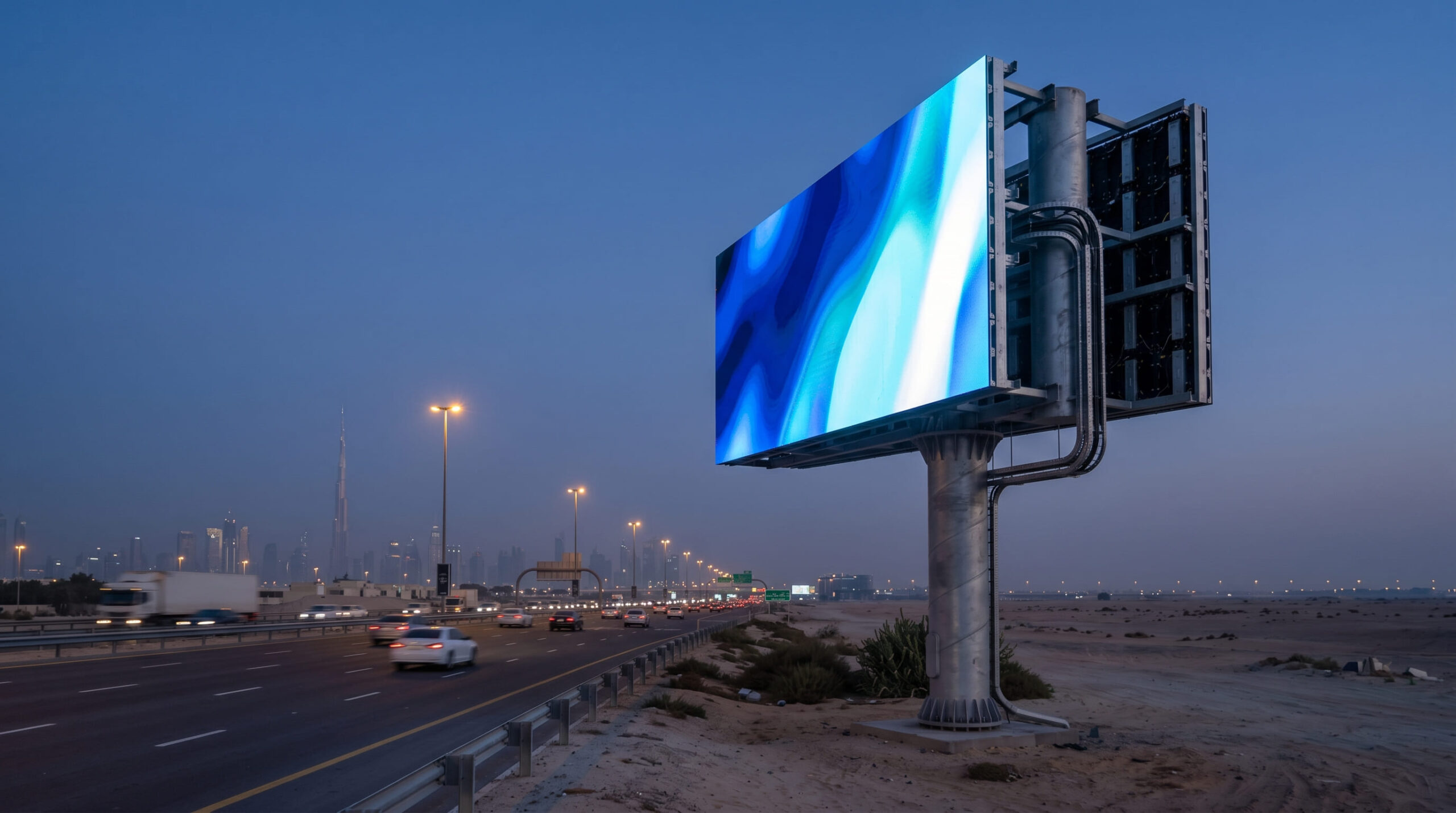
- Outdoor LED displays and billboards – P4 to P10, IP65 front-rated, for facades, roadside, and venue perimeters.
- Transparent and glass LED – for retail facades and showroom windows where you still need to see through.
- Kinetic LED – for experiential installations and lobbies where panels move in choreographed sequences.
- Interactive conference and meeting room displays – touch-enabled fine-pitch panels with collaboration software.
- Digital kiosks, totems, and poster screens – vertical and freestanding format for wayfinding and advertising.
- Mesh, flexible, and curved LED – for architectural curves, column wraps, and feature ceilings.
Each format has a specific use case, and the wrong category – even with the right brand – will cost more to fix than to specify correctly upfront.
Why Digital Displays Matter More in 2026
Three things have changed the UAE digital display market over the last two years.
Content quality is no longer negotiable
Audiences in Dubai and Riyadh now expect retail and corporate environments to look at least as good as their phones. A P4 outdoor screen that looked impressive in 2021 looks pixelated against a 4K social feed today. Specifications have tightened across the board — fine-pitch indoor walls under P1.5 are now standard for boardrooms, not exotic.
Saudi Vision 2030 events have raised the floor
Activations for LEAP, Joy Forum, and the World Cup 2034 build-up have pushed Riyadh into a steady cycle of high-spec temporary and permanent installations. Many UAE integrators now plan their year around Saudi event windows, which has lifted the baseline spec on both sides of the border.
Climate compliance is a real spec criterion
Outdoor displays in the UAE deal with sustained 45 to 50 degree ambient temperatures, sand ingress, and over 80% humidity during summer evenings. A spec that works in London or Hamburg will not survive a Sharjah Corniche installation without changes to cooling, IP rating, and surge protection.
For 2026, the practical implication is simple: pixel pitch is finer, brightness targets are higher, and the gap between “compliant” and “good” has widened. Cutting corners on processor quality, cabinet IP rating, or content management is the most common reason replacements come earlier than they should.
Core Concepts: What Actually Drives a Display Spec
Five things define whether a digital display solution will work for your use case. Get these right and the rest of the spec sheet follows.
Viewing Distance
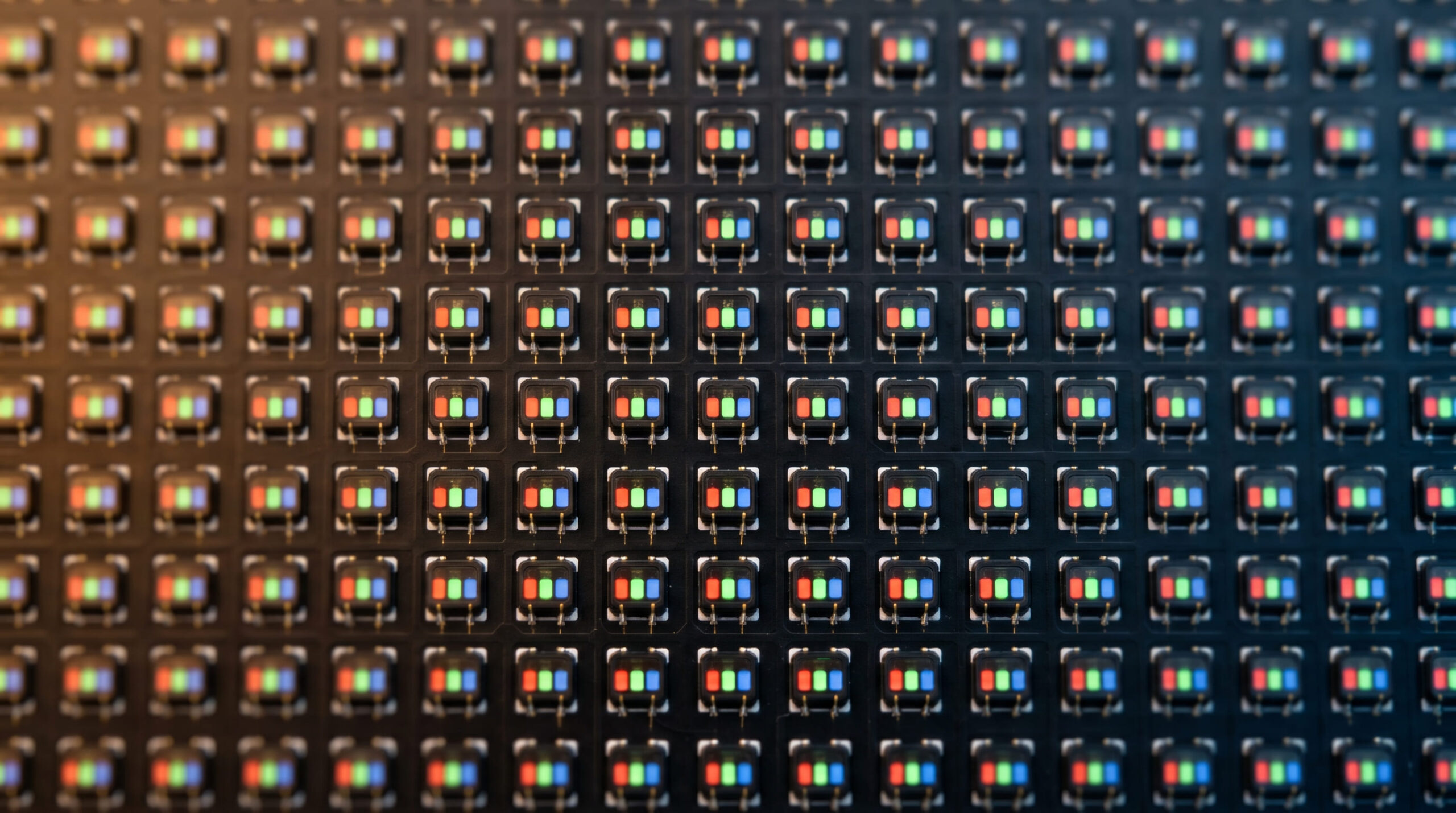
The single most important number. A useful rule of thumb: minimum viewing distance in metres roughly equals pixel pitch in millimetres. A P3 screen is best viewed from 3m or further; a P1.5 looks clean from 1.5m. Closer than that, your eye starts resolving individual LEDs. Further than that, you are overpaying for resolution nobody will see.
Brightness (Nits)
Indoor screens in retail and corporate settings usually need 600 to 1,200 nits. Semi-outdoor installations under canopies need 2,500 to 4,000 nits. Outdoor displays facing direct UAE sun need 5,500 to 7,500 nits to remain legible. Anything above 8,000 nits is reserved for billboard-class displays facing east or west at peak hours.
Refresh Rate
3,840 Hz or higher is now the broadcast and event standard. Below that, screens flicker visibly on camera – a serious problem for any installation where photos and video will be shared. For internal corporate use without broadcast, 1,920 Hz remains acceptable.
IP Rating
IP65 front and IP54 rear is the minimum for any outdoor UAE installation. Anything less and sand will eventually find a way in. Glass-fronted models and fully sealed IP66 cabinets are worth the premium for coastal locations like Jumeirah, Yas Island, and the Corniche.
Content Management System (CMS)
The screen is the easy part. The CMS – how you schedule, update, and monitor content remotely – is what determines whether the system stays useful in year two. A capable CMS supports scheduled playlists, remote brightness control, fault reporting, and multi-screen sync. Skipping this and using local USB updates is the single biggest reason installations end up underused.
How to Specify a Digital Display Solution: Step by Step
This is the sequence we follow on every BeBright project. Following it in order avoids 90% of the issues that come up later.
- Define the use case and audience. Is the screen for branding, wayfinding, advertising, broadcast, or experiential content? Who is meant to look at it, and from how far away? Write this down before you ask for a quote.
- Lock the location and viewing geometry. Indoor or outdoor. Wall-mounted, ceiling-hung, floor-stacked, or freestanding. Closest viewer distance, furthest viewer distance, and likely viewing angles. Measure the actual installation surface – not the architect’s drawing.
- Calculate the right pixel pitch. Use the minimum viewing distance as the anchor. A boardroom seating people 2m away needs P1.5 or finer. A mall atrium seen from 8m away can use P3 or P4 without anyone noticing. Spending on a finer pitch than the room needs is wasted money.
- Choose the display technology. SMD remains the workhorse for P1.5 and above. COB is now the better choice for fine-pitch below P1.5 because of its impact resistance and heat dissipation. Transparent LED is for windows where you still need to see through the glass. Mini-LED is appearing in premium boardroom installations.
- Size to cabinet modularity. Most cabinets come in fixed module sizes (commonly 480mm or 500mm). Your final screen dimensions need to multiply cleanly. A 4.32m x 2.43m wall built from 480mm cabinets is fine; a 4.20m x 2.30m wall forces awkward partial cabinets.
- Plan power and structure. Indoor walls typically draw 100 to 200 W per square metre at peak brightness. Outdoor displays can exceed 500 W. The wall behind the screen needs to carry the cabinet weight plus service load. Concrete-block walls almost always work; gypsum partitions almost always need reinforcement.
- Select the processor and signal path. Sending card, receiving cards, signal distribution, redundancy. For event use, dual-redundant processors are worth the cost. For permanent retail, single-path is acceptable if the CMS reports faults clearly.
- Specify the content management system. Cloud-based or local-network. Number of users. Scheduling needs. Remote monitoring. This is the most under-specified line item on most quotes – and the one you will feel every week after the install.
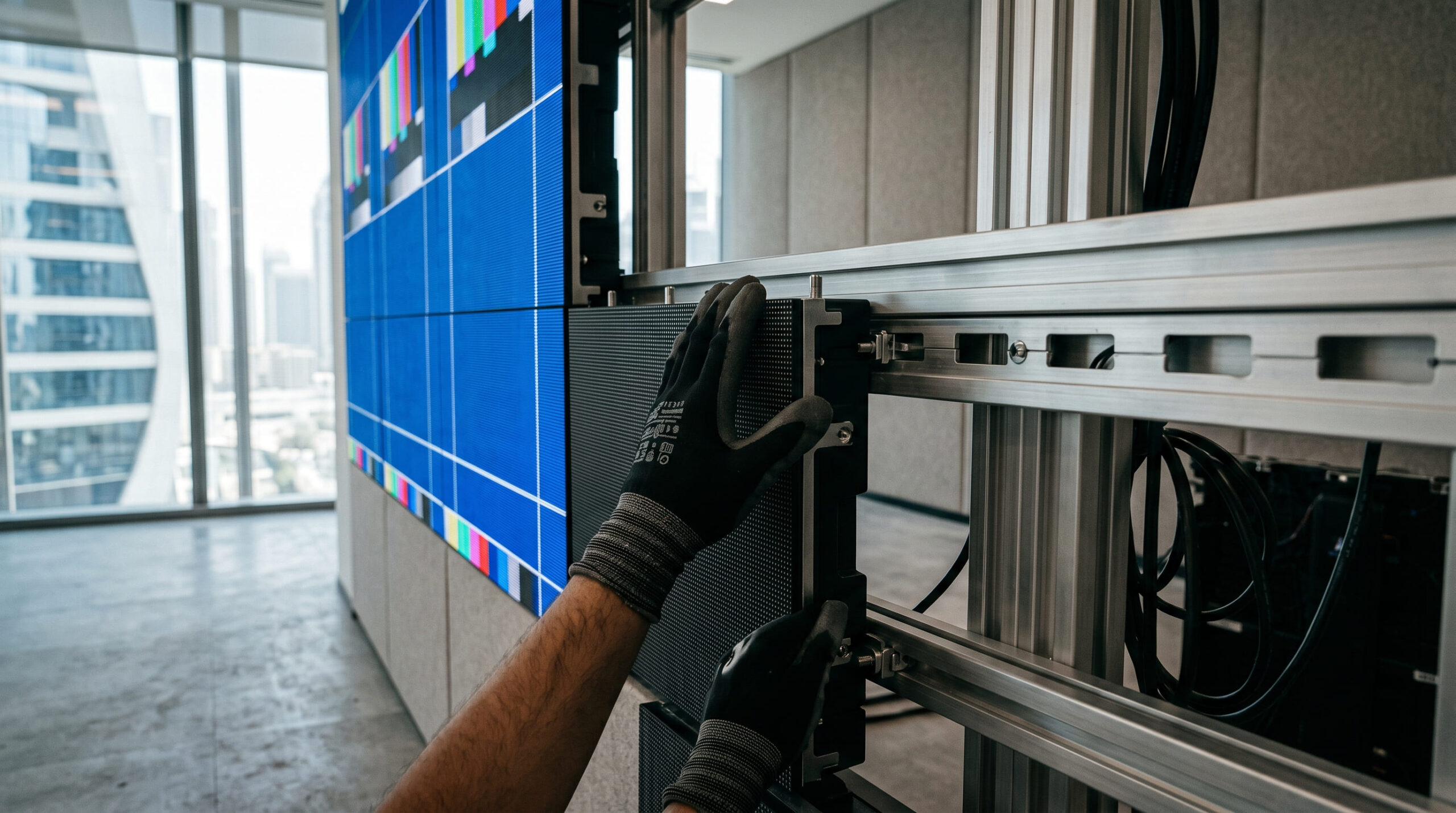
- Plan installation and commissioning. Site access, working-at-height permits, content load, color calibration, and warranty start date. UAE installations often need Dubai Municipality or RTA approval for outdoor signage; factor that into the timeline.
- Define the maintenance plan. Cleaning schedule, spare modules on site, response time for fault calls, and annual calibration. A two-year-old screen without these in place will look noticeably worse than its installation-day baseline.

Expert Insights from UAE Integrator Practice
A few things we have learned across hundreds of UAE and KSA installations that do not appear on spec sheets.
Buy spare modules at install
Module-level color consistency drifts over time. Replacement modules ordered 18 months later rarely match. The fix is to buy 3 to 5% spare modules from the same production batch and keep them on site.
Front-service access pays for itself
Front-serviceable cabinets cost more upfront. They save it back the first time a module fails on a wall mounted flush against masonry. For any wall installation in the UAE, front-service is the default we recommend.
Calibrate twice
New LEDs settle over the first month. A calibration done on install day will drift. The second calibration, around 30 days later, locks the wall in. Skipping this is one of the most common reasons a wall looks slightly off two months after handover.
Plan content before screen size
Content built for a 16:9 ratio looks awkward on a 3:1 architectural wall. Decide what plays on the screen before you commit to the dimensions, not the other way round.
Cooling matters more than people think
Even indoor LED walls generate significant heat. In Dubai mall environments, ambient temperatures in service corridors behind walls can run 5 to 8 degrees above the public-facing floor. Factor active cooling into any wall above 10 square metres.
For outdoor in the UAE, COB has a heat advantage
SMD outdoor displays work – but COB’s resin-encapsulated package handles thermal cycling and sand exposure with less long-term degradation. The premium is worth it for installations facing direct sun.
Real World Examples
BeBright has delivered digital display solutions for clients across retail, automotive, government, and corporate sectors in the UAE and Saudi Arabia.
Luxury Retail – Cartier
Fine-pitch indoor LED for boutique environments where the screen sits within 2m of customer viewing. Specification anchored on color accuracy and seamless cabinet alignment. Calibration was the deliverable, not the resolution.
Automotive Showroom – Ferrari
Showroom display work where the brand standard is uncompromising. The screen had to disappear behind the content. We worked to a fine-pitch SMD spec with above-broadcast refresh rate so the wall photographed cleanly on every brand asset shoot.
Energy Sector – ADNOC
Corporate AV and control-room display work where uptime is the priority. Redundant signal paths, scheduled maintenance access, and integration with existing AV infrastructure mattered more than the headline pixel pitch.
Public Sector – Dubai Police
Operational display environments where readability under varying lighting conditions, multi-source signal input, and 24/7 reliability define the spec.
The pattern across all four: the screen is specified backwards from how it is used, not chosen first and made to fit.
Future Trends Shaping UAE Digital Display in 2026
COB displacing SMD at the fine-pitch end
Below P1.2, COB is increasingly the default. Better heat handling, better impact resistance, lower long-term failure rates. Expect SMD’s premium fine-pitch market share to keep shrinking.
Mini-LED and Micro-LED moving from spec sheets to project reality
The first commercial Micro-LED video walls landed in the UAE market in late 2025. Pricing is still high but on a steady glide path down. By 2027, Micro-LED is likely to be standard for premium boardroom installations.
AI-driven content scheduling
CMS platforms now ship with audience-aware playlist optimization. Retail installations in Dubai Mall and Mall of Emirates are using these features in production, not pilot. Expect this to become a standard CMS feature within the next 12 months.
Energy efficiency under scrutiny
The UAE Energy Strategy 2050 has pushed power draw into specification conversations. New cabinet generations from Tier-1 manufacturers are running 20 to 30% below 2022 power figures at the same brightness.
Transparent and creative LED in retail facades
Sheikh Zayed Road retail and DIFC tower lobbies are increasingly specifying transparent LED for storefronts. The format is no longer experimental — it is a real category with proven installations across the UAE.
8K ready video walls
Not a 2026 mass requirement, but every premium boardroom and broadcast install is now being sized to support 8K when source content catches up.
Muhammed Shameer
Muhammed Shameer is an LED and AV Solutions Specialist at Bebright Global with over 8 years of hands-on experience delivering commercial LED display and audio-visual projects across the UAE, Saudi Arabia, and the wider GCC. His work spans indoor and outdoor LED screen installations, AV system integration for corporate offices and boardrooms, and display solutions for retail, hospitality, and government environments.