Trusted partner in LED and AV Solutions




An outdoor LED mesh screen is a lightweight, semi-transparent LED display (3–10 kg/sqm, 50–90% transparency) built for large-scale building facades where structural load and natural light are design constraints. Bebright Global supplies and installs outdoor LED mesh screens across Dubai, Abu Dhabi, Sharjah, and Saudi Arabia, with free site assessment, structural load analysis, permit coordination, and full after-sales support.
Outdoor LED mesh screens are lightweight, semi-transparent LED display systems built for large-scale building facade installations. Unlike solid outdoor LED panels, mesh screens allow 50 to 90 percent of ambient light to pass through the display surface – making them the correct specification for glass-curtain commercial towers, retail mall exteriors, and high-rise architectural media projects where structural load and natural light are design constraints.
Bebright Global supplies and installs outdoor LED mesh screens across Dubai, Abu Dhabi, Sharjah, and Saudi Arabia – including Riyadh, Jeddah, Dammam, and Al Khobar. Every project includes free site assessment, structural load analysis, permit coordination, and full after-sales support.
The commercial buildings of Dubai's DIFC and Business Bay, Abu Dhabi's Corniche, and Riyadh's King Abdullah Financial District share one defining architectural characteristic: glass-curtain facades with structural load limits that make standard outdoor LED cabinet systems impossible to specify. These buildings require a display solution that delivers strong visual impact from street level while imposing minimal weight and wind resistance on the building structure.
Outdoor LED mesh screens solve this directly. The open, cabinetless aluminium frame structure weighs 3 to 10 kg per square metre compared to 18 to 25 kg for standard solid outdoor LED panels and reduces wind load resistance by up to 70 percent. This means a 100-square-metre outdoor LED mesh installation on a high-rise glass-curtain facade imposes the same structural load as a standard indoor LED screen of the same size. For architects, structural engineers, and building managers across the UAE and Saudi Arabia, this changes what is possible.
Bebright Global's outdoor LED mesh screen programme covers supply, structural coordination, installation, calibration, permit documentation, and long-term maintenance for building facade projects of any scale across the UAE and Saudi Arabia. We do not supply mesh screen panels without professional integration.
What Is an Outdoor LED Mesh Screen?
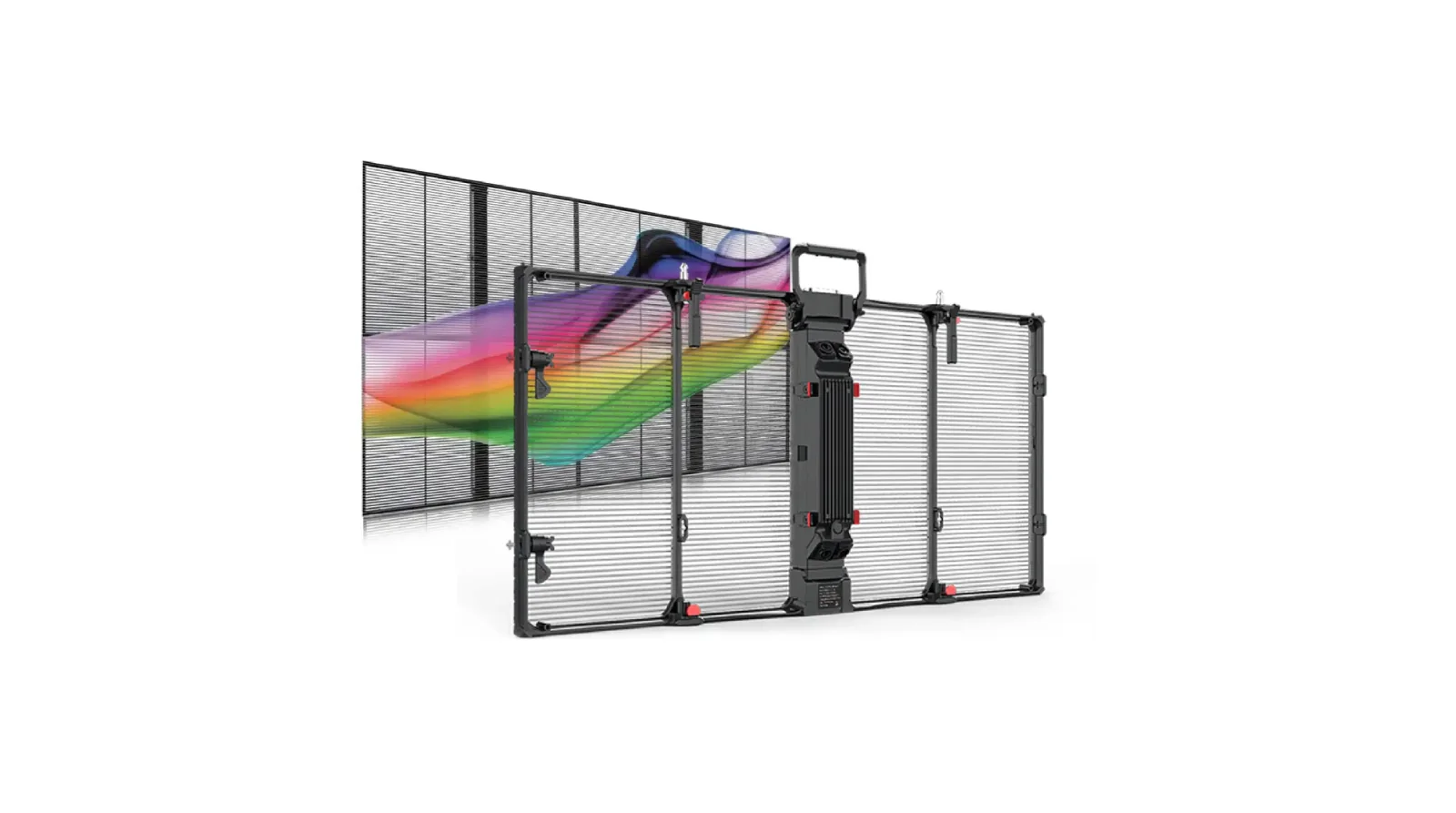
An outdoor LED mesh screen is a large-format LED display built on an open, cabinetless aluminium frame rather than a sealed enclosure. The LED strip elements are mounted within a mesh or lattice structure, with deliberate open spacing between them. This open structure allows air, wind, and ambient light to pass through the display surface – producing the defining characteristics that make mesh screens the correct technology for high-rise building facade applications.
Standard outdoor LED screens are built inside sealed aluminium cabinets, completely opaque and solid. Mesh screens replace the cabinet structure with a lightweight aluminium profile grid. When the screen is not displaying content, the facade behind remains partially visible through the mesh. When content plays, the LED elements illuminate to produce high-brightness video visible from street level or from vehicles in traffic.
The practical result is a display technology that can be scaled to entire building faces wrapping towers of 50, 100, or 200 metres in height without exceeding the structural load capacity of glass-curtain facade systems. For landmark commercial buildings, retail developments, hospitality properties, and government infrastructure projects across the UAE and GCC, outdoor LED mesh is the technology that makes building-scale media facades viable.
| Specification | Outdoor LED Mesh Screen | Standard Outdoor LED Screen |
|---|---|---|
| Weight per sqm | 3 to 10 kg | 18 to 25 kg |
| Transparency | 50 to 90% | 0% (fully opaque) |
| Wind resistance | Reduced by up to 70% | Full wind resistance |
| Structural load | Minimal — suitable for glass-curtain facades | Significant — requires reinforced mounting |
| Pixel pitch range | P10 to P100 | P2.5 to P16 |
| Brightness | 5,000 to 7,000 nits | 6,500 to 10,000 nits |
| Best viewing distance | 10 to 100+ metres | 5 to 200 metres |
| Cabinet system | Cabinetless aluminium profile | Sealed die-cast aluminium cabinet |
| Heat dissipation | Natural ventilation through mesh | Active thermal management required |
| Best application | High-rise glass facades, large building wraps | Ground structures, rooftop, solid facades |
Outdoor LED Mesh Screen Technical Specifications – UAE & GCC Configuration
All outdoor LED mesh screens supplied by Bebright Global are specified and configured for Gulf climate performance. The specifications below reflect UAE and Saudi Arabia installation requirements – not generic global ratings.
| Specification | Value / Range | UAE & GCC Buyer Notes |
|---|---|---|
| Brightness | 5,000 to 7,000 nits | Daylight visible; adequate for direct UAE sunlight on facade-mounted screens |
| Pixel Pitch | P10 to P100 | Select based on viewing distance – see pixel pitch guide |
| Transparency | 50% to 90% | Higher transparency = lighter weight and more light through; lower pitch = more detail but less transparency |
| Weight per sqm | 3 to 10 kg depending on pixel pitch | P50 approx 8.5 kg/sqm; P100 approx 3 kg/sqm – well within glass-curtain load limits |
| IP Rating | IP65 minimum; IP67 for coastal sites | IP65 fully dust-tight, water jet resistant; IP67 for Dubai Marina, Palm Jumeirah, Abu Dhabi Corniche, Jeddah waterfront |
| Operating Temperature | -30°C to +60°C | Rated above UAE peak summer ambient of 48 to 50°C; mesh ventilation assists heat dissipation |
| Wind Load Resistance | Up to 200 km/h | Mesh structure reduces wind pressure by up to 70% vs solid panels; critical for high-rise UAE installations |
| Screen Thickness | 15 to 25 mm | Ultra-slim profile; no protrusion from facade surface |
| Cabinet Material | Aluminium profile, cabinetless | Corrosion-resistant; marine grade available for coastal UAE sites |
| Flexibility | Bendable to curved facades | Suitable for concave, convex, and irregular architectural surfaces |
| Refresh Rate | 1,920 Hz minimum | Clean display without flicker for camera and broadcast-facing installations |
| Lifespan | 80,000 to 100,000 operating hours | 9 to 11 years at 24/7 operation with standard maintenance |
| Power Consumption | 80 to 200W per sqm (lower than solid screens) | Lower LED density than solid screens reduces energy costs significantly for large facade installations |
| Content Management | Cloud-based CMS compatible | Remote scheduling and monitoring from any location; no on-site controller required for updates |
Why Outdoor LED Mesh Screens Are Specified for UAE and Saudi Arabia Building Facades
The Gulf's commercial architecture creates specific conditions that make outdoor LED mesh screens the technically correct choice — not a niche alternative — for the majority of large-scale facade LED projects.
Glass-Curtain Building Prevalence in Dubai and Riyadh
The majority of premium commercial towers completed in Dubai since 2010 — across DIFC, Business Bay, Downtown Dubai, Jumeirah Lakes Towers, and Dubai Marina — use glass-curtain wall construction. The same applies to Riyadh's King Abdullah Financial District, Olaya Street tower corridor, and major retail developments in Jeddah. Glass-curtain facades have defined load limits per square metre for facade-attached elements. Standard solid outdoor LED cabinets at 18 to 25 kg per sqm routinely exceed these limits.
Outdoor LED mesh screens at 3 to 10 kg per sqm resolve this constraint completely. A 100-square-metre outdoor mesh installation on a glass-curtain tower adds 300 to 1,000 kg of distributed facade load — versus 1,800 to 2,500 kg for the equivalent solid LED installation. For building structural engineers across the UAE and Saudi Arabia, this difference determines whether a project proceeds or requires structural reinforcement costing as much as the LED installation itself.
Wind Load on High-Rise Installations in the UAE
Wind load calculations are mandatory for any facade-mounted structure in Dubai and Abu Dhabi. UAE building codes require structural certification for facade elements exposed to prevailing winds, particularly on buildings above 50 metres. The open mesh structure of LED mesh screens allows wind to pass through rather than pressing against a solid surface. Drag coefficients for mesh LED systems are typically 0.2 to 0.3 — compared to 1.2 to 1.8 for solid LED panels. On a 200-square-metre high-rise facade installation, this difference in wind load can be the deciding factor in whether the existing facade fixings can support the installation without structural modification.
Natural Ventilation – A Thermal Advantage in the Gulf Climate
Solid outdoor LED cabinets generate internal heat from their own operation. In UAE summer conditions where ambient temperatures reach 48 to 50 degrees C, managing this heat requires active cooling systems within sealed enclosures. The open mesh structure eliminates the sealed enclosure entirely — heat from LED modules dissipates naturally through the mesh into the ambient air. This is a meaningful operational advantage in the Gulf: lower maintenance requirements, longer component lifespan, and no risk of cooling system failure at peak summer temperatures.
Aesthetic Integration with Premium Architecture
For landmark commercial buildings in DIFC, Emaar developments in Downtown Dubai, and premium hospitality properties across the UAE and Saudi Arabia, the visual appearance of the display during daytime hours - when the screen is not running content — is an architectural consideration. Solid outdoor LED panels create an opaque, visually heavy addition to a facade. Mesh screens are semi-transparent: during daylight hours the building facade remains partially visible through the mesh, and the display blends with the building surface rather than dominating it. At night or when content plays, the full visual impact of the LED installation is delivered.
Types of Outdoor LED Mesh Screens Bebright Global Supplies
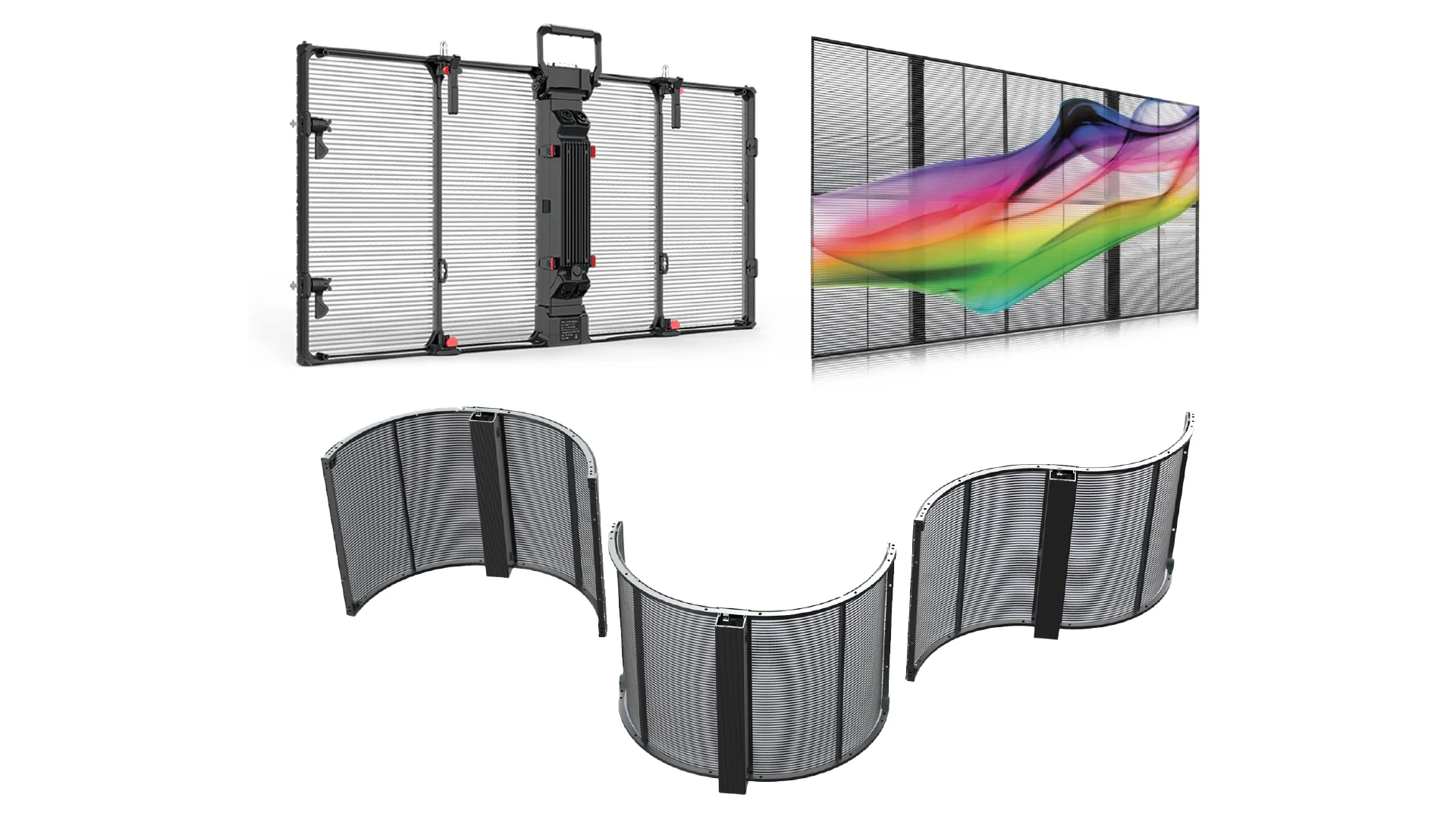
Bebright Global supplies three categories of outdoor LED mesh screen for UAE and GCC commercial projects. Each has distinct structural and visual characteristics suited to different facade applications:
Standard Outdoor LED Mesh Screens
Fixed rigid aluminium profile grid panels, modular and scalable. The most widely specified outdoor LED mesh product for permanent commercial building facade installations in the UAE and Saudi Arabia. Available in pixel pitch P10 to P100, brightness 5,000 to 7,000 nits, IP65 or IP67 rated. Individual LED strip elements are replaceable without removing the panel from the facade – minimising maintenance downtime on permanent installations.
Outdoor Flexible LED Mesh Screens
Flexible LED strip curtain systems that conform to curved, concave, convex, and irregularly shaped architectural surfaces. The flexible mesh structure can be shaped to fit cylindrical towers, curved atrium canopies, archway entrances, and non-planar facade features. The correct specification for buildings with curved glass-curtain facades common in landmark architectural projects across Dubai and Riyadh. Transparency up to 90 percent. Weight from 2 kg per sqm for wide-pitch flexible configurations.
Outdoor Customised LED Mesh Screens
Bespoke outdoor LED mesh configurations for unconventional facade geometries, unusual aspect ratios, or creative outdoor media installations that do not conform to standard product dimensions. Customised mesh projects include full building wraps with irregular window voids, architectural feature elements integrated into facade cladding, LED mesh integrated with facade lighting systems, and multi-surface installations across complex building envelopes. Full structural engineering coordination, weatherproofing specification, and regulatory permit support included.
Permit Requirements for Outdoor LED Mesh Screen Facade Installations in UAE and Saudi Arabia
Installing an outdoor LED mesh screen on a building facade in the UAE or Saudi Arabia requires regulatory approval before installation begins. Bebright Global coordinates the complete permit process as part of every project, but the framework below gives buyers the planning information they need from the outset.
Dubai: RTA, Dubai Municipality, and Trakhees
In Dubai, facade LED screens visible from public roads require Roads and Transport Authority (RTA) approval. Screens on private building facades require Dubai Municipality sign permit approval. Installations within free zones such as JAFZA, Dubai Media City, or DIFC require Trakhees or the relevant free zone authority approval. Required documentation typically includes technical drawings, structural engineering load calculations, electrical schematics, brightness specifications, and a signed NOC from the building owner. Dubai permit lead times are typically 4 to 8 weeks from full submission. See here for outdoor LED screen permit guide for Dubai.
Abu Dhabi: DMT and ADDC
In Abu Dhabi, outdoor facade display approvals are issued by the Department of Municipalities and Transport (DMT). Screens connected to the public electrical grid require coordination with Abu Dhabi Distribution Company (ADDC) for the power supply connection. Abu Dhabi applies brightness restriction requirements for screens near residential zones, requiring automatic dimming to comply with the light pollution ordinance during specified evening hours — a standard feature of all Bebright Global installations.
Saudi Arabia: SAIP and Municipal Approvals
In Saudi Arabia, outdoor advertising screens on public roads require approval from the Saudi Authority for Intellectual Property (SAIP) and the relevant regional municipality. Large-scale facade installations and screens in government zones may require additional approval from the Ministry of Municipal and Rural Affairs and Housing (MMRAH). Vision 2030 infrastructure projects on NEOM, Red Sea Project, or KAFD sites have their own project authority approval processes. Bebright Global's Riyadh office manages all Saudi regulatory requirements for outdoor LED mesh screen projects.
Outdoor LED Mesh Screen Types We Supply