Trusted partner in LED and AV Solutions




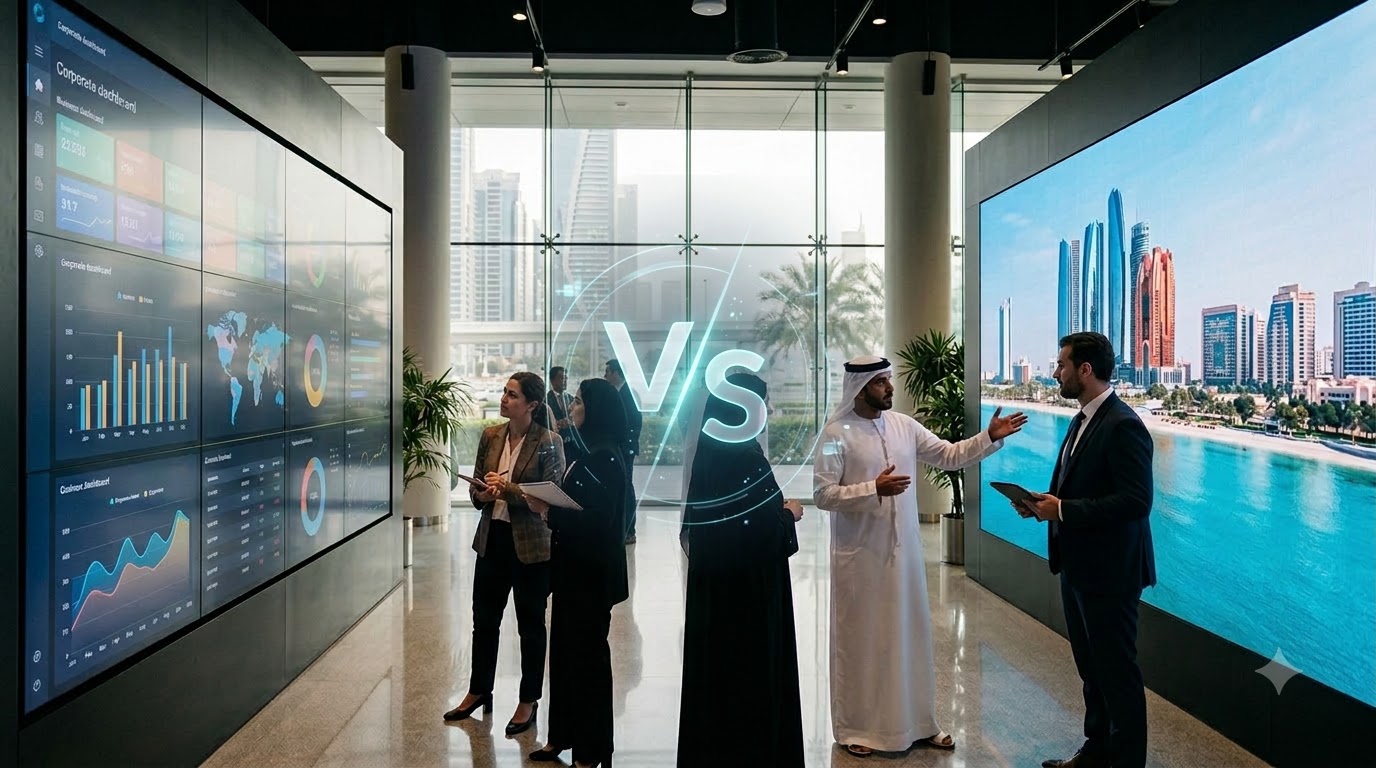

For businesses in Abu Dhabi, LED video walls also known as direct-view LED or dvLED are the better long-term option for lobbies, retail flagships, control rooms and any outdoor or sun-exposed installation. These LED video walls are brighter than LCD video walls, which range from 500 to 700 nits while LED video walls can go up to 800 to 8,000+ nits. LED video walls handle the heat and glare in the UAE better than LCD video walls and they have no visible seams. LCD video walls are still a choice for budget-conscious indoor setups. These include meeting rooms, back-of-house dashboards and smaller retail counters. In these cases viewers are close to the light. The upfront cost is more important than the scale. The right choice depends on how people will view the display whether it is, inside or outside the budget and how long the display needs to last in the climate of Abu Dhabi.
What Is an LED Video Wall?
An LED video wall, also called a direct-view LED or dvLED is made from panels. Each pixel is its light source, a small group of red, green and blue diodes. There is no backlight and no bezel between panels. Therefore the modules fit together to create one image in almost any size or shape, even curves and corners.
Key entities to know:
- Pixel pitch: the distance in millimetres between pixels. A smaller pitch, such as 0.9mm to 1.5mm gives detail for close viewing. A larger pitch, such as 4mm to 10mm or more is used for outdoor viewing and costs less per panel.
- SMD vs. COB: Surface-Mount Device LEDs are the discrete-diode construction. Chip-on-Board LEDs encapsulate the LEDs for durability, better contrast and protection against dust. This is important in Abu Dhabi’s high-UV environment.
- Cabinet/module: the tile, commonly 500mm by 500mm or 500mm by 1000mm that locks into the array. Most commercial installs use serviceable modules so a faulty section can be swapped from the front in minutes.
- IP rating: an Ingress Protection rating, such as IP65 shows how dust and water resistance the LED video wall has. This matters for any LED wall that faces Abu Dhabi’s heat, humidity and blowing sand.
What Is an LCD Video Wall?
An LCD video wall is a grid of commercial‑grade crystal display panels that are put together edge to edge. Each panel has its LED backlight that shines through a liquid‑crystal layer. The image quality comes from flat‑panel TV and monitor technology so the native resolution and color fidelity stay fixed and are very high. This makes the LCD video wall perfect for detailed text‑heavy content that people look at close.
Key entities to know:
- Bezel width: the visible seam between panels is usually between 0.88 mm and 3.5 mm on commercial‑grade panels. Even the thinnest bezel can be seen up close. That is why LCD video wall works best with content that is made to fit a grid of a single borderless image.
- Panel lifespan: commercial LCD panels are usually rated for 50,000 to 60,000 hours before the backlight starts to degrade. After that brightness drift appears, making older panels dimmer than ones on the same LCD video wall.
- Backlight type: edge‑lit and direct‑lit LED backlighting control how bright the LCD video wall’s how even the light is across the panels and how much heat is produced. This matters in air‑conditioned buildings in places, like Abu Dhabi.
- Video wall controller: the processor that takes one image or several sources and spreads them across the panel grid of the LCD video wall just like it does for walls.
LED vs. LCD Video Wall: Side-by-Side Lifespan to half Brightness Comparison
| Attribute | LED Video Wall | LCD Video Wall |
| Brightness (indoor) | 800–2,000 nits | 500–700 nits |
| Brightness (outdoor-rated) | 5,000–8,000+ nits | Not suitable outdoors |
| Seams/bezels | None — fully seamless | Visible bezel, 0.88–3.5mm per panel |
| Pixel pitch | 0.9mm (fine) to 10mm+ (outdoor) | Fixed by panel native resolution |
| Lifespan to half brightness | 100,000+ hours | 50,000–60,000 hours |
| Screen size/shape flexibility | Scales to almost any size, curves, corners | Limited to panel multiples, flat only |
| Viewing distance | Flexible by pixel pitch; fine-pitch works up close | Best suited to close-to-mid viewing |
| Upfront Cost | Higher — roughly 2–4x an equivalent LCD wall | Lower — typically half to a quarter of LED |
| Maintenance | Front-serviceable, module-level repair | Panel replacement more involved |
| Outdoor/sun suitability | Purpose-built for direct sunlight and heat | Not rated for outdoor or high-glare use |
Why Abu Dhabi’s Climate and Market Effect the Decision
Abu Dhabi’s environment is harsher on displays than western markets. So, the LED versus LCD walls comparison changes for local businesses in Abu Dhabi.
- Extreme heat
Summer daytime highs in Abu Dhabi regularly reach 38–43°C (100–109°F) from June to September with August the month. Any display that faces a space. A mall entrance, a petrol station canopy, an outdoor majlis or a storefront that looks out onto the corniche. Needs a cooling and heat‑management design that can handle sustained desert heat, not the mild climates many panel datasheets are tested in.
- High humidity on the coast
Coastal humidity in Abu Dhabi reaches 60% or higher during summer and peaks near 70% in winter months. Sealed, IP‑rated LED cabinets resist condensation and corrosion better than LCD panels, which are not designed for semi‑outdoor exposure.
- Sun and UV
Direct sun and UV (peak index above 10 in June) wash out lower‑brightness displays. LCDs 500–700 nit ceiling is best for indoor under controlled lighting but struggles against Abu Dhabi’s sunlight through glass façades or in open‑air retail. This is one reason that outdoor and near‑window installs on the Corniche in malls such as Yas Mall or The Galleria and at Abu Dhabi Global Market lean toward high‑nit LED displays.
- Dust
Fine desert dust infiltrates ventilation. Can abrade components over years of exposure. IP65‑rated LED modules with sealed fronts are the specification for any semi‑outdoor installation in the UAE.
- Corporate procurement
Abu Dhabi’s public‑sector and semi‑government entities, such as the Department of Government Support, ADNOC and Mubadala‑linked companies typically specify display durability, energy efficiency and total cost of ownership in RFPs. These criteria show that LEDs’ longer lifespan often offsets its upfront price over a 5–10 year horizon.
- Retail and hospitality density
Abu Dhabi’s mall, hotel and flagship‑retail market. Yas Mall, Marina Mall, The Galleria, Reem Mall, they increasingly use LED video walls as a branding center piece because of their scale and seamless finish. LCD remains common, for wayfinding, menu boards. Back‑of‑house information displays.
Cost and Total Cost of Ownership in the Abu Dhabi Market
Upfront price typically favors LCD. A commercial LCD video wall usually costs between one half and one quarter of the price of a LED wall and the main factor that drives LED cost is pixel pitch – a 2mm – pitch LED wall is much more expensive than a 10mm – pitch LED wall of the same size.
But upfront price is part of the Abu Dhabi cost picture:
- Energy and cooling: LED walls are generally more power‑efficient per unit of brightness than LCD backlights and this matters when year‑round air conditioning and display cooling both use the same electricity bill.
- Lifespan economics: LED has a lifespan of over 100,000 hours to half brightness about double the lifespan of LCD that’s 50,000–60,000 hours. Thus over a 24/7 retail or control‑room deployment an LED wall can outlast two LCD replacement cycles.
- Maintenance access: Serviceable LED modules reduce technician callout time and avoid dismantling a wall‑mounted structure providing a meaningful saving for businesses that pay UAE service contract rates.
- Heat‑driven derating: LCD backlights degrade faster when the ambient temperature stays high which can shorten the working life of an LCD wall in an Abu Dhabi environment below its rated spec. This hidden cost favors LED for anything outside climate‑controlled interiors.
- As a rule of thumb: if a display is expected to run for 5 or more years in Abu Dhabi conditions, model the total cost of ownership combining purchase, install, energy, maintenance and expected replacement cycle and not just the quoted panel price.
Best Use Cases for Abu Dhabi Businesses
Choose LED when you need:
- Outdoor or semi‑outdoor signage – building façades, drive‑through canopies, Corniche‑facing storefronts, stadium or event screens
- A flagship retail, hospitality or showroom centrepiece where brand impact and seamless scale matter – hotel lobbies, luxury auto showrooms, mall atriums
- Control rooms and operations centres – utilities, oil and gas ports, security monitoring – where 24/7 uptime and long lifespan reduce downtime risk
- Large‑format displays viewed from a distance, where bezels would break up the image.
- Curved, non‑rectangular or very large installations that LCD cannot physically match
Choose LCD when you need:
- Indoor meeting rooms, boardrooms or collaboration spaces with controlled lighting and close viewing distances
- Detailed text‑or data‑heavy content – dashboards, trading floors, control panels – where native high resolution matters more than seamlessness
- A budget or a pilot installation before committing to a larger LED investment
- Shorter‑term deployments – pop‑up retail temporary exhibition stands, seasonal campaigns
- Back‑of‑house or lower‑traffic areas where a visible bezel is an acceptable trade‑off, for lower cost
Decision Checklist: LED or LCD?
Work through these questions before specifying a video wall:
- Will the display face direct sunlight, heat or dust at any point in the day? Yes → LED. No (fully indoor, climate-controlled) → either, continue.
- How close will the nearest regular viewer stand? Under 2m with detailed content → LCD or fine-pitch LED. Over 3–4m → LED.
- Does the content/brand need a single seamless image, or is a visible grid acceptable? Seamless → LED. Grid acceptable → LCD.
- What is the expected operating life of the installation? 5+ years, 24/7 → LED’s longer lifespan offsets the higher upfront cost. Under 2 years or temporary → LCD may be more economical.
- What is the available budget today? Tight budget, indoor-only → LCD. Budget allows and the use case justifies scale → LED.
- Does the shape need to be curved, very large or non-standard? Yes → LED is the only practical option.
Most Abu Dhabi businesses land on LED for anything public-facing, outdoor, or brand-critical, and LCD for internal, budget-sensitive or short-term indoor needs.
Frequently Asked Questions
Is LED or LCD better for outdoor video walls in Abu Dhabi?
LED is the only suitable option for outdoor or sun-exposed installations in Abu Dhabi. LED walls reach 5,000–8,000+ nits of brightness and use IP-rated, sealed cabinets that resist heat, humidity and dust, while standard LCD panels are not rated for outdoor use and max out around 500–700 nits.
Which is cheaper: LED or LCD video walls?
LCD has the lower upfront cost — typically half to a quarter the price of an equivalent LED wall — but LED’s longer lifespan (100,000+ hours vs. 50,000–60,000 hours for LCD) and lower maintenance needs can make it more cost-effective over a 5–10 year deployment.
Can LCD video walls handle Abu Dhabi’s heat and humidity?
LCD video walls are designed for indoor, climate-controlled environments. Abu Dhabi’s summer heat (up to 43°C) and coastal humidity (60%+) can accelerate backlight degradation in LCD panels, so they should be limited to fully air-conditioned indoor spaces.
What pixel pitch should Abu Dhabi retailers use for an indoor LED video wall?
For close-viewing retail and lobby displays, a fine pixel pitch of 1.2mm–2.5mm is typical. As a guide, multiply the pixel pitch (in mm) by 3 to estimate the minimum legible viewing distance in feet, and by 10 for the ideal viewing distance.
Do LED video walls have visible seams like LCD?
No. LED video walls are fully seamless because each pixel is an individual light source across the whole array. LCD video walls always have a visible bezel between panels, typically 0.88mm–3.5mm wide on commercial-grade panels.
How long do LED and LCD video walls last?
Commercial LED video walls typically reach 100,000+ hours before brightness drops to half their original level. Commercial LCD panels are typically rated for 50,000–60,000 hours before backlight degradation becomes visible.