Trusted partner in LED and AV Solutions




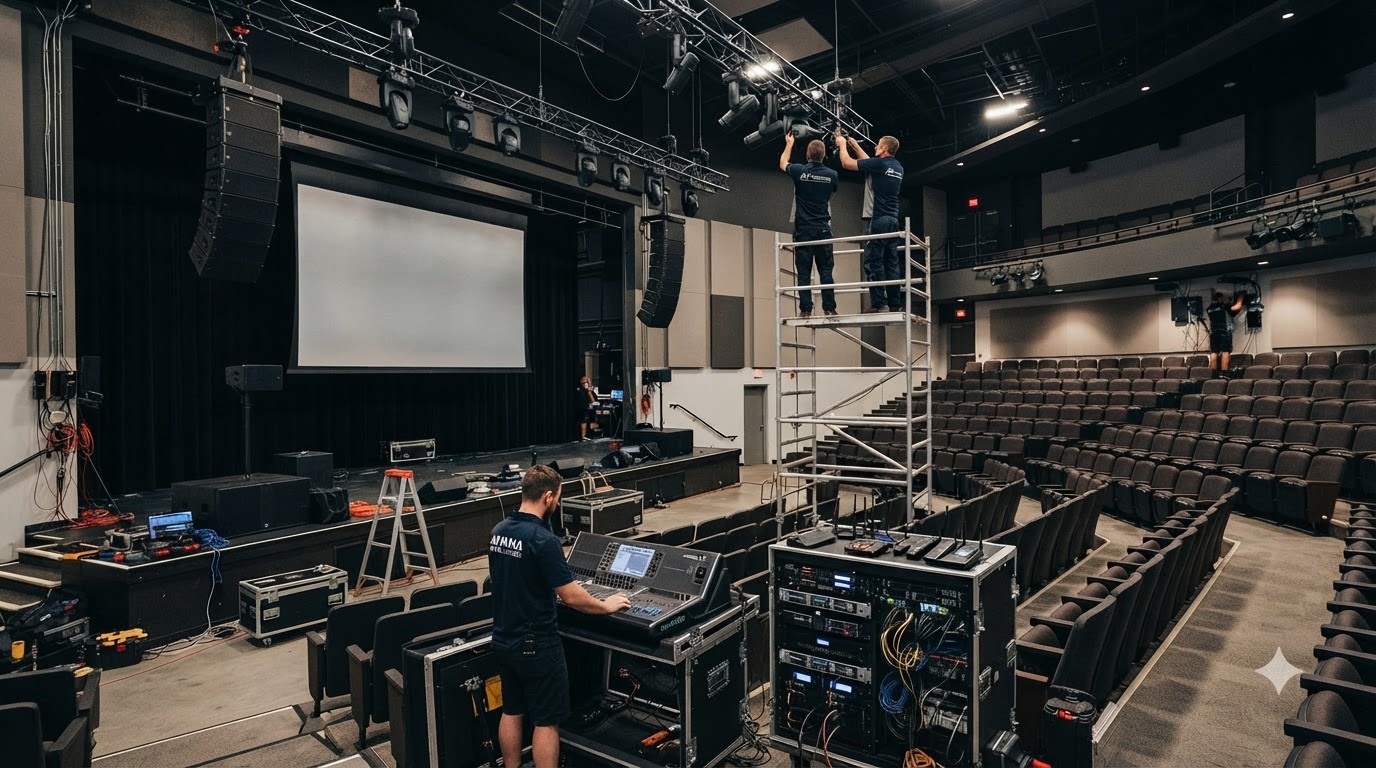

A professional AV install for an auditorium can cost from about $15,000 for a small, no-frills setup to $500,000 or more for a large venue with a full sound system, video wall, and integrated controls. If you’re working with a mid-size room with 300 to 800 seats and want something solid without going overboard, plan on somewhere between $75,000 and $250,000.
The auditorium av install cost depends on how many seats you’re covering, what tier of equipment you choose, whether you’re going with a projector or an LED wall, and how much usable infrastructure is already sitting in the room.
Let’s get into what actually drives that number, piece by piece, so you can walk into vendor conversations knowing what you’re really paying for.
Why the Price Fluctuate So Much
An “AV system” isn’t really one thing you buy. It’s several separate systems (audio, video, control, wiring) bundled together, and each one scales differently depending on the room and how it’s used.
A church running a livestream every Sunday needs something very different from a 1,200-seat theater or a corporate auditorium built for quarterly town halls.
A few things tend to move the needle more than anything else:
1.How many seats you’re filling.
More seats means more coverage area, which means more speakers and more power behind them.
2. How complex the audio needs to be.
A handful of ceiling speakers for a PA system costs a fraction of what a properly tuned line array for a 1,000-seat hall runs.
3.Projector or LED wall.
Projectors are usually the cheaper option upfront, but LED walls tend to pay for themselves over time in rooms that get a lot of ambient light and less bulb replacement, better visibility.
4.How smart the control system needs to be.
A basic volume knob and a mic switch are cheap. A fully programmed Crestron or Q-SYS setup with presets, scheduling, and remote access are costly. But it’s also a lot easier for staff to run day to day.
5.What’s already in the walls.
If there’s usable cabling, conduit, and rigging points already in place, labor costs drop quite a bit. If you’re starting from a bare shell, expect to pay for all of that wiring from scratch.
What It Actually Costs, by Room Size
| Auditorium Size | Seating | Estimated Cost Range | What You’re Usually Getting |
| Small | Under 300 seats | $15,000 – $50,000 | Basic ceiling speakers or PA, one or two wireless mics, a single projector or display, a simple control panel |
| Mid-Size | 300 – 800 seats | $75,000 – $250,000 | Line-array or distributed speakers, a proper mixing console, 4 – 8 wireless mic channels, projector or LED wall, DSP tuning, a programmed control system |
| Large | 800 + seats | $250,000 – $500,000+ | Full line-array with subwoofers, broadcast-quality mixing, large-format LED wall, streaming and recording built in, real acoustic treatment, redundant controls |
Take these numbers as a starting point, not a quote. Labor rates, local market conditions, union rules, and what’s already installed in your building can all push things up or down significantly.
Before you commit to a budget, get two or three vendors to actually walk the room, remote estimates rarely hold up once someone sees the space in person.
DIY vs. Hiring an Integrator
| Buying It Yourself | Hiring an Integrator | |
| Upfront cost | Lower | Higher |
| Who owns the design risk | You do | The integrator does |
| Acoustic tuning | Usually skipped or done poorly | Part of the process |
| Installation | You or a general contractor | Trained AV technicians |
| Warranty | Scattered across different manufacturers | Usually one unified agreement |
| Long-term reliability | More likely to need rework later | Lower risk |
What’s Really in a Complete Auditorium AV
Once you receive a number from a vendor, it’s easy to view it as a single total. But it’s actually composed of several separate components, and understanding what those are helps you identify when a “ cheap” quote is subtly omitting important details.
Audio
This covers your speakers (line-array or point-source), subwoofers, amps, DSP for tuning the room, wireless mic systems, and the mixing console. Audio is usually the biggest single chunk of the budget in any properly specced system.
Video
If you go with a projector-and-screen combo or an LED wall, plus any switchers, scalers, or cameras if you’re recording or streaming. LED walls cost more going in but generally hold up better in rooms with a lot of natural light, and you don’t need to swap bulbs every year.
Control systems
This is the part that lets staff actually run the room pulling up presets, switching video sources, adjusting levels from one touch panel instead of a dozen separate controls. Programming and commissioning this properly takes real time, and it’s one of the easiest things to underestimate on a budget.
Infrastructure and cabling
Conduit, cable runs, rigging hardware, and whatever electrical work is needed to support it all. If you’re doing this in an existing building rather than new construction, this is usually where DIY budgets get blown, running cable through finished walls and ceilings is slow, labor-heavy work.
Acoustic treatment
Panels, ceiling clouds, bass traps – whatever it takes to keep the room from sounding boomy or muddy. You can spend a fortune on speakers and still end up with bad sound if the room itself isn’t treated.
ADA and assistive listening
Most public auditoriums are legally required to offer assistive listening. An induction loop or an RF/IR receiver system for patrons who are hard of hearing. This isn’t a nice-to-have; budget for it from the start rather than bolting it on later.
Design, labor, and commissioning
The site survey, the acoustic modeling, the actual install, and the testing that happens before completing the system. Most integrators fold this into the overall project cost rather than breaking it out line by line.
Training and support
Someone on staff needs to know how to run this thing after the installers leave, and you’ll want a warranty or support agreement in place. It’s easy to forget about this until you actually need it.
The Costs People Forget to Budget For
These are the things that quietly don’t show up on a headline number, so it’s worth asking about each one directly:
- Cabling and conduit beyond what you can see in the room
- Permits and electrical work, especially in older buildings
- Acoustic treatment, which some vendors quote as a separate scope
- ADA-compliant assistive listening systems
- Time spent on programming and commissioning, not just hardware
- Staff training
- Ongoing maintenance – a lot of facilities budget for the install and get blindsided by the first annual service bill
It’s Not Just the Install – It’s What Happens After
The purchase price is only part of the story. A realistic budget also needs to account for:
- Annual maintenance contracts – which usually run a percentage of what you paid to install the system and cover firmware updates, preventive checks, and priority repairs.
- Equipment lifespan – Projectors, amps, and wireless mic gear don’t all wear out at the same rate, so it’s worth planning for a partial refresh down the line instead of getting surprised by it.
- Software and licensing renewals – since some control platforms and streaming tools come with ongoing subscription costs.
Facilities that only plan for the install often run into a second, unplanned expense a few years down the road. Sketching out a rough five-year total-cost-of-ownership number alongside your install quote goes a long way toward avoiding that.
Auditorium AV Integration in Dubai
If you’re planning a project in the UAE, it helps to see how a real integrator approaches auditorium work. Bebright Global, based in Deira, Dubai, is one of the av integrators active in this space across the UAE, Saudi Arabia, and the broader GCC.
Bebright Auditorium’s AV solutions serve schools, government buildings, cultural centers, lecture halls, and corporate spaces, with a focus on large-format LED screens designed according to the room’s viewing distance, seating arrangement, and acoustics, all core principles we’ve covered above.
- Bebright is a full-service, turnkey integrator handling everything from the initial site assessment through installation, calibration, and long-term support, rather than just supplying hardware.
- Bebright works alongside AV consultants, architects, and interior designers during the planning phase, which is common practice for larger auditorium builds where the AV system needs to be designed into the room rather than retrofitted afterward.
- Beyond auditoriums, Bebright global have a broader portfolio spans corporate boardrooms, command centers, retail, and large-scale experiential installations including work at venues like the Dubai World Trade Centre.
This blog isn’t a specific cost benchmark. The pricing for any UAE auditorium project will depend on the same factors covered throughout this guide (room size, equipment tier, existing infrastructure)
But it’s a useful real-world reference point for what “full-service integration” looks like in practice, and a reminder that in markets like Dubai, a free site assessment is usually the standard first step before any real numbers get discussed.
Frequently Asked Questions
How much does auditorium sound system installation cost per seat?
The cost varies a lot by system tier, but audio tends to eat up the largest share of the overall budget, that is often 40–50% of the total project. Since coverage and clarity both scale directly with how big the room is.
Do I need a permit or electrician for AV installation?
In most places, any new electrical circuits, high-voltage runs, or structural rigging for speakers and projectors will need permits and licensed electrical work. Rules vary by location, so check with your local building department or ask your integrator.
What’s the average lifespan of auditorium AV equipment before replacement?
Projector lamps and wireless mic batteries need attention fairly often, while speakers, amps, and control processors can often go 7–10+ years with proper maintenance before a full refresh is needed.
What ongoing maintenance costs should I budget for after installation?
Most facilities set aside an annual maintenance or support contract to cover firmware updates, preventive checks, and faster repair response. It’s a recurring cost separate from the initial install, so plan for it from year one rather than adding it later.