Trusted partner in LED and AV Solutions




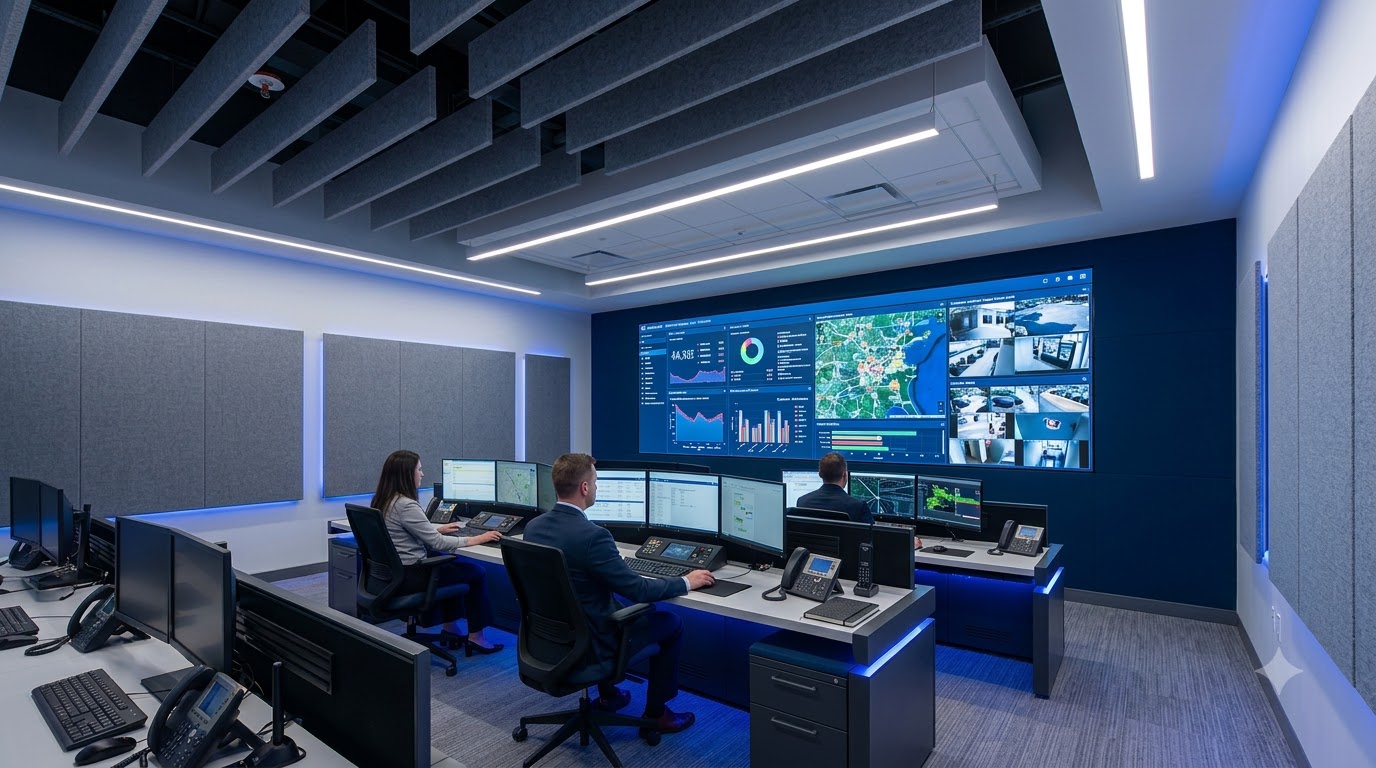

In mission-critical spaces like Network Operations Centers (NOCs), Security Operations Centers (SOCs), and emergency management facilities, the display wall is the central focal point of the environment.
However, an enterprise video wall cannot function in isolation. When designing a 24/7 environment, architects, interior designers, and AV consultants face a complex spatial challenge “how to harmonize high-brightness visual systems with precise ambient lighting and controlled room acoustics.”
If lighting creates glare across monitor surfaces or if acoustic reflections turn operator chatter into an intolerable echo, the efficiency of the entire facility drops. Operators suffer from visual fatigue, reduced situational awareness, and cognitive burnout during critical 12-hour shifts.
To build a high-performance command center, design teams must integrate three essential environmental pillars: optical control (lighting), structural acoustics, and fine-pitch Chip-on-Board (COB) LED display technology.
The Optical Equation: Balancing Lux Ratios and Video Wall Glare
A major mistake in traditional command center design is treating room lighting and display specification as separate tasks. Standard surface-mounted LED walls (SMD) or legacy LCD arrays often struggle with severe ambient light interference. High ambient light washes out screen contrast, while lowering light levels turns the video wall into an uncomfortably bright light source in a dark room.
Optimise Lux Ratios
To maintain optimal visual contrast without straining operator eyes, architects should aim for a 3:1 brightness ratio between the active display wall and the immediate surrounding background wall.
- Task Surface Illumination – 300 to 500 lux directly at operator consoles for comfortable reading and typing.
- Ambient Room Illumination – 100 to 150 lux in general circulation zones to maintain situational alertness.
- Display Output Alignment – Video walls should automatically calibrate between 200 and 600 nits, depending on active ambient light conditions.
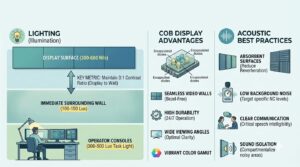
- Task Surface Illumination – 300 to 500 lux directly at operator consoles for comfortable reading and typing.
- Ambient Room Illumination: 100 to 150 lux in general circulation zones to maintain situational alertness.
- Display Output Alignment: Video walls should automatically calibrate between 200 and 600 nits, depending on active ambient light conditions.
Acoustic Engineering Rules for Command Center Video Walls
To counteract the acoustic reflection of a large glass or resin display, architects must compensate across the remaining five room surfaces (ceiling, floor, side walls, and rear wall):
- Target Reverberation Time ($RT_{60}$)
Maintain an $RT_{60}$ between 0.4 and 0.6 seconds in the 500 Hz to 2,000 Hz speech frequency range.
- Ceiling Treatment (NRC $\ge$ 0.85)
Install suspended acoustic baffles or high-NRC acoustic ceiling tiles directly in front of and above the video wall array to trap initial acoustic reflections.
- Rear Wall Absorption
The wall directly behind operator consoles should feature micro-perforated acoustic paneling or fabric-wrapped sound absorbers to prevent voice echo from returning to the front of the room.
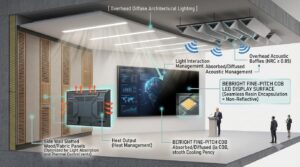
- Slotted Wall Framing around Video Walls
When recessing a video wall into a stud cavity, frame the perimeter with acoustic insulation materials rather than hollow drywall cavities, which can act as resonant sound boxes.
Thermal Management and HVAC Noise Reduction
A frequently overlooked aspect of command center acoustics is HVAC noise. HVAC noise is the unwanted sound generated by heating, ventilation, and air conditioning systems, coming from mechanical parts like motors, fans, and compressors, or from air moving fast through ducts.
Traditional displays generate significant thermal output, forcing HVAC systems to run at high fan speeds to cool the room. This introduces low-frequency background hum (Noise Criteria levels above NC-40) that interferes with operator communication.
Thermal Efficiency of COB Displays
COB technology alters this thermal dynamic through direct board-level heat dissipation:
- Flip-Chip COB Efficiency – Direct contact with the substrate PCB dissipates thermal energy across the panel frame, eliminating concentrated hot spots.
- Lower Operating Temperatures – COB panels run up to 30% cooler than equivalent-brightness SMD displays.
- Fanless Operation – Fine-pitch COB cabinets operate silently without internal cooling fans.
Lower display heat output means HVAC systems can be specified with lower cubic-feet-per-minute (CFM) targets, enabling low-velocity air diffusers that keep room ambient noise below NC-30 to NC-35.
Architectural Specification Checklist
When developing BIM models, CAD layouts, and AV spec sheets for a command center video wall, use this baseline checklist:
| Design Dimension | Technical Benchmark | Design Strategy |
| Display Reflection | Matte / Anti-Glare Resin Surface | Specify Fine-Pitch COB LED (e.g., P0.9 to P1.2 pitch) with resin encapsulation over traditional SMD. |
| Sightline Ergonomics | Max $45^\circ$ vertical viewing angle | Position video wall base height relative to seated console eye-level (typically 42″ to 48″ AFF). |
| Room Acoustics ($RT_{60}$) | 0.4 – 0.6 seconds | Offset hard display surface with NRC 0.85+ ceiling baffles and rear wall acoustic absorption. |
| Ambient Lighting | 100–150 lux ambient / 300–500 lux task | Use indirect, dimmable 3500K/4000K linear LED fixtures placed parallel to the display wall. |
| HVAC Noise Criteria | $\le \text{NC-35}$ | Leverage fanless COB displays to reduce overall room heat load and lower air supply velocity. |
Seamless Integration Starts at Design
Designing an effective command center requires balancing human ergonomics, acoustic control, lighting design, and display performance. By replacing reflective, high-heat traditional displays with fine-pitch COB technology, architects and AV consultants can streamline spatial integration, reduce background room noise, and build visually comfortable environments built for continuous 24/7 operations.
This is where Bebright fits into the process. Our command centre AV solution isn’t positioned as a drop-in replacement for a legacy wall. They’re engineered as environmental infrastructure, built to reduce glare, run cooler, and take pressure off the HVAC and acoustic systems around them.
If you’re scoping a command center build in the UAE and want display specification aligned with your lighting and acoustic plan from day one, Bebright’s team can join that conversation early before the drawings are locked.